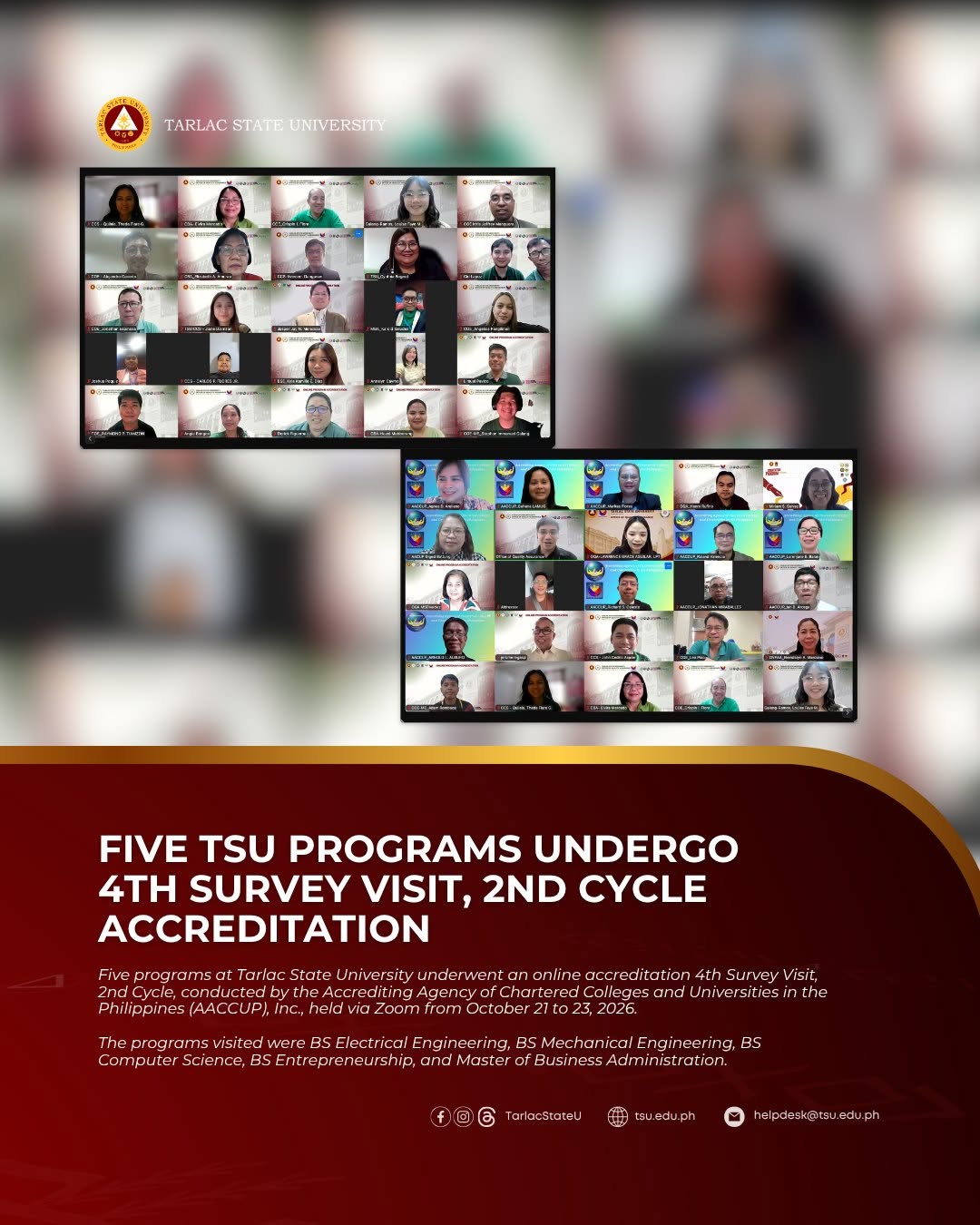
Five programs at Tarlac State University underwent an online accreditation 4th Survey Visit, 2nd Cycle, conducted by the Accrediting Agency of Chartered Colleges and Universities in the Philippines (AACCUP), Inc., held via Zoom from October 21 to 23, 2026.
The programs visited were BS Electrical Engineering, BS Mechanical Engineering, BS Computer Science, BS Entrepreneurship, and Master of Business Administration.
University President Dr. Jasper Jay N. Mendoza expressed that the accreditors' recommendations should be welcomed.
“Tanggapin, tugunan at tuparin. A recommendation is not a judgment on our way. It is a map of where to go next. Kung may malasakit sa narinig natin, pakinggan natin nang mas maigi; doon po kadalasan [matatagpuan] ang pinakamahalagang aral,” the president said.
The accreditors shared their overall impressions and presented their findings during the joint closing program, where Dr. Agnes Arellano, coordinator for MBA and BS Entrepreneurship (Cluster 2), lauded the two programs and affirmed their sustained excellence.
Dr. Arellano led the Cluster 2 Survey Team together with Dr. Giged Battung, team leader from Cagayan State University, and Dr. Ian Arcega, lead accreditor from Capiz State University for the MBA program; while Prof. Richard Celeste, team leader from Mindanao State University – Marawi, and Dr. Gehana Lamug, lead accreditor from Camarines Norte State College, for the BS Entrepreneurship program.
"Achieving true quality is not [a] one-time job. It is a continuous process of learning and getting better every day. The real test of any quality assurance is the success of your graduates and how well they perform in the real world; accreditation is just getting a seal of approval, and it shows how dedicated the university is in offering education," Dr. Arellano said.
She also highlighted the MBA’s outstanding excellence, operational alignment, and transformative societal impact across four evaluation areas.
The program maintained full compliance with CMO No. 15, s. 2018, maintained a strict 1:5 advisor-to-student ratio, and remained consistent in international conference presentations.
Dr. Arellano said that the program (MBA) can be further elevated by integrating modern business analytics software and expanding tracer studies that will include direct employer feedback, and a document tracer of study findings for curriculum revisions.
For the BS Entrepreneurship, Dr. Arellano emphasized the importance of promoting research culture and disciplinary expertise. She said that the program has shown a continuous improvement in response to the needs of aspiring entrepreneurs. She recommended institutionalizing plans, evaluating the system, and gathering the stakeholders' feedback for curriculum development.
She noted the importance of establishing a departmental operational plan with clear targets, timeliness, and budget allocations.
Meanwhile, AACCUP Survey Team Cluster 1 was led by Dr. Roland Valencia from the Rizal Technological University (RTU), supported by Prof. Julius Sareno, team leader from Technological University of the Philippines, and Dr. Lorenjane Balan, lead accreditor from Batangas State University for the Computer Science Program; Prof. Arnold Alburo, team leader from Isabela State University; and Engr. Marites Flores, lead accreditor from Capiz State University for the Electrical Engineering program; and Engr. Irene Lara Abad, team leader from Mindanao State University, and Prof. Jonathan Miraballes, lead accreditor from Cebu Technological University for the Mechanical Engineering program.
Dr. Valencia said the extension activities showed admirable commitment to community development by applying electrical engineering knowledge to practical local needs.
He also recommended that BSCS adopt a research development plan with targets for every faculty member, mentoring peers and student co-authorship, and streamlining the process from proposal through ethics review, with clear timelines and online tracking.
He emphasized the importance of running a tracer study every 1 to 5 years after graduation. Dr. Valencia said it is important to include employer feedback surveys, eligibility exams, and industry certification by cohorts. He commended the effectiveness of the preparation for the Electrical Engineering Licensure Examination, which exceeded the national passing rate as well as its topnotchers.
While on all the programs his team has handled, he advised seeking quality publication venues, securing external funding, and pursuing patents and utility models. He said Intellectual Property Protection, technology transfer, and prototype validation should be strengthened. He also encouraged institutionalizing and strengthening plans for curriculum development and aligning the TSU research agenda from 2024 to 2026 to provide a foundation for strengthened research.
On behalf of the accredited programs, College of Engineering Dean Dr. Miriam S. Galvez pledged their unwavering commitment to upholding the highest standards, integrity, and service.
"We dedicate ourselves to nurturing our students, supporting our faculty and staff, and ensuring that our programs remain relevant, responsive, and future-ready,” she said.
Meanwhile, Office of the Quality Assurance Director Dr. Henry D. Rufino said that the accreditors are partners in advancing quality assurance.
“You are not only accreditors or assessors of our programs, but you are champions, and now our partners in advancing quality assurance across our instruction, research, extension, administration, and all the services that support our students and the entire university community and stakeholders,” he said in his closing speech.
All findings will be compiled and submitted to the AACCUP technical panel for review. The official result will then be communicated to TSU.